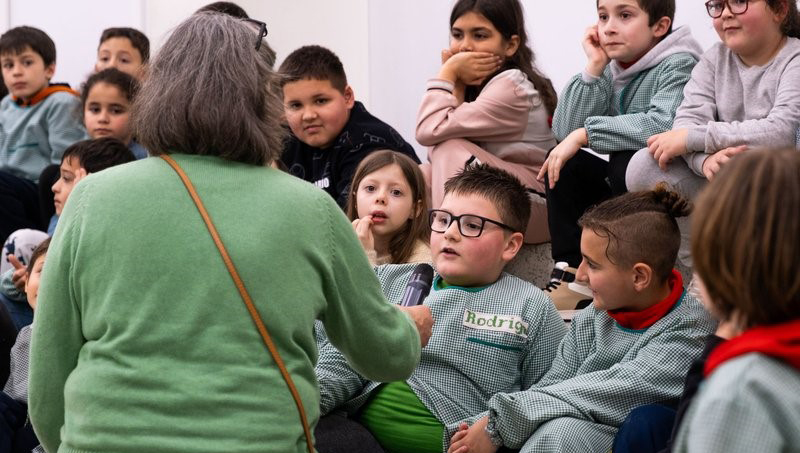
It all began with a model showcasing the various Nature-Based Solutions that can be found at Escola Básica do Falcão so that, over the past year, students could discover everything that exists beyond the classroom in terms of biodiversity — “the collection of living beings: plants, animals, and us,” João explains. And what else? “Fungi,” adds his classmate Francisco. Two years after the start of the initiative “My School is Green”, as part of the European project “LIFE-myBUILDINGisGREEN”, it was the children themselves who gave a lesson… to their parents.
They can explain by heart the difference between moss and lichen, help each other point out the importance of cork and green façades for classroom comfort, describe animals they never dreamed existed, and tell everyone that most of the energy used at the school comes from the sun through the photovoltaic panels on the roof — which is also green, “full of grass.”
“Bees help to keep us alive. If they didn’t exist, we wouldn’t exist either.” At just nine years old, João Guilherme Pinho knows more than many adults about important environmental issues and wants everyone to understand that “biodiversity is very important for our planet.”
Proud of his “green school that helps the environment,” the boy admits the joy it was to “go learn outside, leave the school, go to the garden, and see the pond.” Every day brought a surprise, like when he managed to find, for the first time, a beetle “right here nearby — I never imagined it,” he confesses.
“[The school] is better with us. Because we are the future of this world.”
His classmate Francisco Soares adds the monarch butterfly and notes that “not all insects are bad — they are good for biodiversity.” “Even if they sting us, it’s because they feel threatened,” he informs us.
In the child’s own words: “My school is green because it is full of forest, full of plants, and all the roofs are green and covered in cork, which means that on hotter days we feel cooler, and on colder days we feel warmer.”
And there is another advantage to this project: “We breathe better when we are close to nature,” he admits, confident in the mission he and his classmates have in their hands — to know how to take care of the school so that the school can take care of them.
Everyone has long understood the most important message: Escola Básica do Falcão — and all the space around it — “is better with us. Because we are the future of this world.”
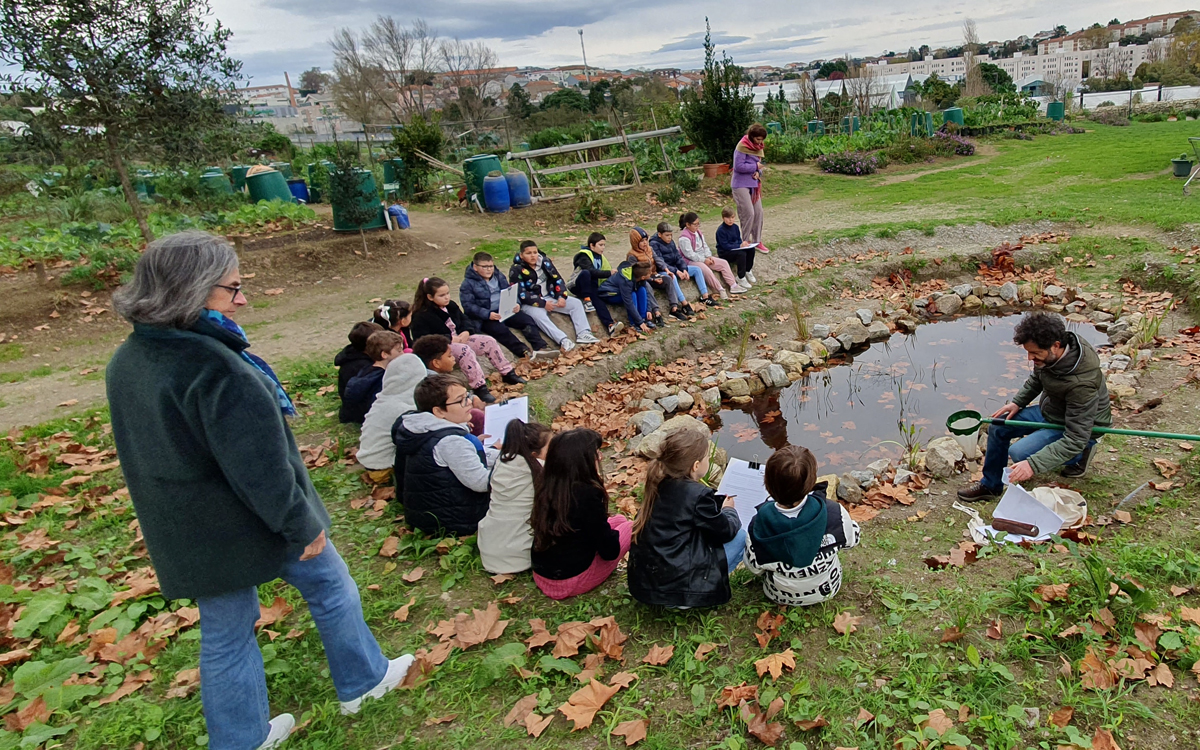
Visit with students to the pond next to the school © Câmara Municipal do Porto
“The school is built by the community. It is with families; it must be a space where we grow together.”
And the Deputy Mayor could not agree more. For Filipe Araújo as well, “this school is very special, with several nature-based solutions — features that make it a green school, I would even say a school of the future.”
Proximity to biodiversity and nature, to the Alameda de Cartes Park and the Oliveira Garden, “is undoubtedly also linked to learning and to the way students learn and absorb knowledge,” he considers.
There is no doubt that “the school is built by the community. It is with families; it must be a space where we grow together,” said the mayor, stating that “our school community — whether the children, the teachers, or the parents themselves — must increasingly realize that within the city there is enormous biodiversity.”
There is no doubt that “the school is built by the community. It is with families; it must be a space where we grow together,” said the mayor, stating that “our school community — whether the children, the teachers, or the parents themselves — must increasingly realize that within the city there is enormous biodiversity.”
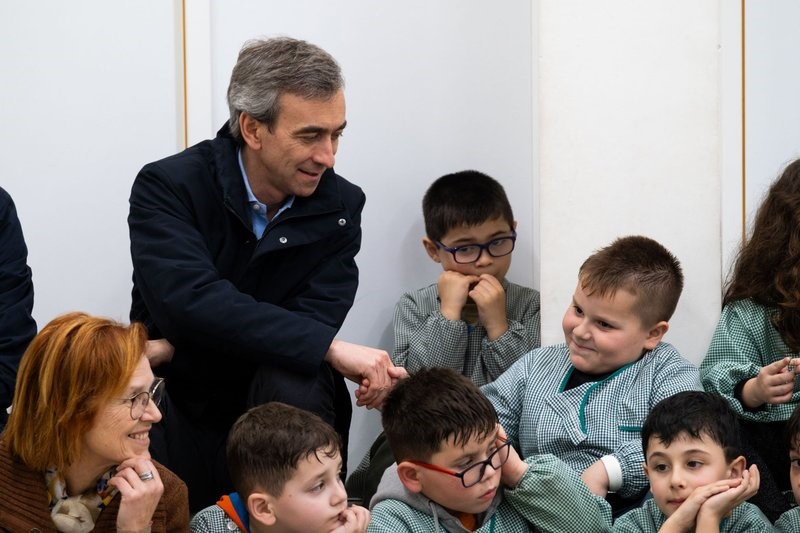
Deputy mayor visits training sessions © Câmara Municipal do Porto
“Children play a lot in playgrounds, but it is equally very important for them to come into nature to play ball, roll on the grass, climb a tree.”
That’s why the official also responsible for Environment and Climate Transition emphasizes how “it is extremely important to take children out of the classroom” to discover, for example, “the birds that people don’t even notice live in the city” or “the ponds that are full of life and that we often undervalue.”
To give the city increasingly greater contact with nature — also to promote mental health, social interaction, and community spirit — the municipality has been investing in expanding green areas, new parks, and new gardens.
“Children play a lot in playgrounds, but it is equally very important for them to come into nature to play ball, roll on the grass, climb a tree,” Filipe Araújo reiterates.
The original news item is available at this link.
To stay up to date with all the latest news related to LIFE-myBUILDINGisGREEN, we recommend following the project’s Twitter and LinkedIn channels.